


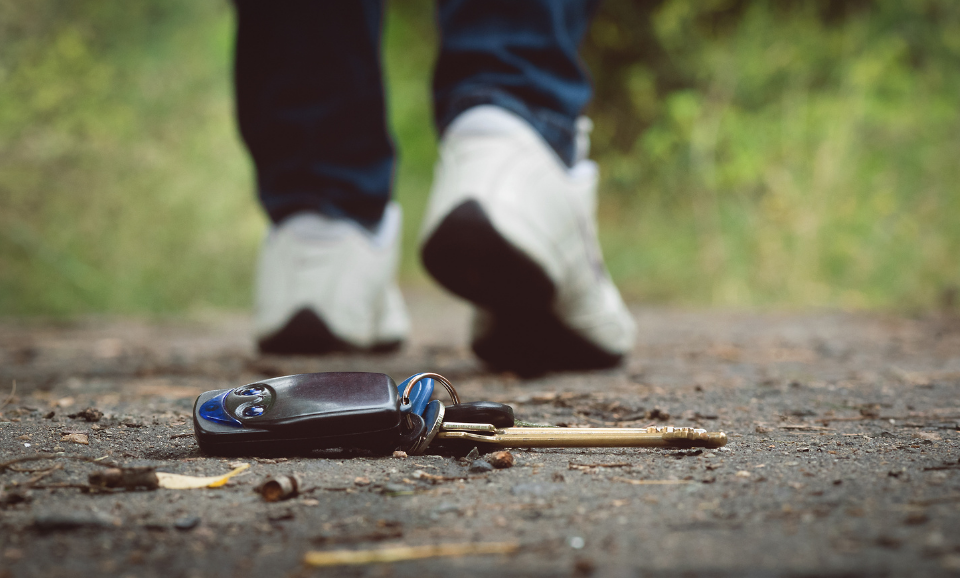
The scenario is simple. You get home late, shopping in one hand, phone in the other, a million things on your mind. You stop at the door, reach into your pocket out of habit… and instead of keys you feel nothing but fabric – quite literally an empty pocket. You rummage through your bag, the car, your work jacket, your child’s backpack. At some point you stop searching and start counting: a locksmith, key cutting, possibly having keys made from scratch, a day off work tomorrow because it all needs sorting out.
Sounds like an episode from someone’s real life rather than an online guide? Rightly so. Estimates from various studies and surveys show that keys are among the top items we lose most often. Right behind them on the podium come wallets and phones. In practice, this means the problem isn’t “niche” – it affects hundreds of thousands of people every year.
So before you reach the point of desperately searching for an emergency locksmith’s number, it’s worth taking a calm look at what losing your keys really involves and whether a key tracker or a small key sensor in the form of a key fob actually makes sense, or is just a gadget. And if you’re curious about how to stop losing your keys, be sure to read our post on “5 ways to stop losing your keys”

How much does it cost to get a key cut?
Google knows the question “How much does it cost to get a key cut” all too well. It’s worth knowing what you’ll be up against in case of an emergency. The answer is an uncomfortable one for all of us: “it depends”. This time it’s not a cop-out, just hard maths.
For house keys, current price lists at key-cutting shops show that:
- a simple copy of a key for a standard lock cylinder costs around PLN 13–30 each – it’s worth remembering to give these copies to someone you trust. That way you may avoid calling a locksmith.
- a security or anti-burglary key usually costs PLN 20–70, depending on the manufacturer and the city.
For a single key, that doesn’t sound alarming. The cost only multiplies when you need more than one copy. In practice, a “quick” visit turns into a bill of around PLN 200–400 before you’ve even touched the lock. Bear in mind that these figures are for ordinary keys – things get much worse with a car. Cutting a plain, old-fashioned mechanical door key is one story, but a modern car key with an immobiliser and remote is a whole different level. Workshops and authorised dealers report that:
- cutting a simpler key with an immobiliser is most often PLN 200–400,
- newer models with a remote and more electronics are in the PLN 300–800 range,
- keyless entry systems can take as much as PLN 800–1,500 out of your wallet for a single key.
If you lose your only set, and on top of that everything has to be recoded from scratch, losing your car keys starts to look like a loan repayment rather than a “minor expense”. In this context, a car key tracker stops being a toy and starts to look like an insurance policy. Compare the cost of a tracker with getting car keys replaced and, in the worst case, it can work out 10 times cheaper.
The locksmith, a lock replacement and all the other hidden costs
The prices above apply to the “light” scenario: you have a spare set, the door can be opened, and the whole thing boils down to ordering new copies. The real problem starts when the lost keys aren’t just for your home, but also: an address on a document in the same bag, company keys to the office or warehouse, keys to the house and garage on a single ring that really could have fallen into the wrong hands.
In that scenario, simply having new keys made isn’t enough. For safety’s sake you need to replace the cylinder or the entire lock. Locksmiths’ price lists are blunt: an emergency opening of a standard door in a larger city is at least PLN 180–200, and with more complex locks and night-time call-outs the amount easily heads towards PLN 400–500 or more.
Add to that a new cylinder, new keys, and sometimes a new remote for the gate or intercom. For a car, in extreme cases, cutting and programming a set of keys can come to well over a thousand złoty. And we still haven’t counted the value of several hours of your time, a wrecked daily schedule and the stress levels.

A key finder – how does it work in real life?
At this point the question naturally arises: “A key finder – how does it work, and does it even make sense?”.
The simplest version is an audible key finder. A small key fob that responds to a button in the app. You press it, the device starts beeping, and that’s it. This kind of key fob with an alarm works brilliantly when the keys are “somewhere in the house”: in another jacket, under a pile of coats in the hallway, behind the sofa, in the pocket of your child’s backpack. It’s a typical key-finding fob that works within earshot and nothing more, but in the chaos of everyday life that’s often all you need.
A Bluetooth key finder goes a step further. On the outside it looks like an ordinary, unremarkable key fob. Inside, though, it has a Bluetooth module for communicating with your phone. Once paired with the app, you can see on a map the last place your bunch of keys was within range of your phone, you can trigger a key alarm, and with some solutions you can use a network of other users that anonymously helps find keys left somewhere further afield, out in town.
In practice it works like this: instead of half an hour of frantic running around the flat, you reach for your phone, launch the key finder, the fob beeps and you follow the sound. If the keys were left at work, the app will show you their last location. It still isn’t GPS for tracking across the whole world, but as a key sensor for keys and other small items it makes a big difference. What’s more, if the tracker is supported by a network of users, there’s a good chance the position of your lost keys will be refreshed fairly often. In a big city you can assume the position should update every 15–20 minutes.
Which key finder to choose and where to buy it?
If you’re wondering which key finder to choose, it’s worth looking for a single, universal solution instead of a collection of different gadgets. The most convenient option is a small key fob with a built-in tracker that combines two functions. First, it works as a key fob with an alarm: one tap in the app triggers a loud signal and you have a simple audible key finder for searching at home. Second, thanks to a Bluetooth connection to your phone, this kind of Bluetooth key finder remembers the last place the keys were within range of your smartphone. That’s enough to cover both ordinary house keys and the more sensitive job of a car key tracker, without buying separate devices “for everything”.
To the question “A key finder – how does it work and where can I buy one?” the answer is simple: you’ll find most of these fobs in electronics shops, on popular online marketplaces and in manufacturers’ official shops. When choosing, what matters more than the logo on the box is whether this little key sensor is convenient to use day to day. In other words, whether the app is simple, the alarm is actually audible, and the device itself doesn’t end up in a drawer after a single use.

notiOne go! PLUS – when a key fob stops being just a key fob
In this context, notiOne go! PLUS looks like a sensible choice. It’s a small tracker in the form of a key fob, designed from the outset precisely for finding keys and other important little things. On the outside it’s an ordinary, unassuming key fob that you can clip to your house keys, your car keys or a backpack. Inside, however, there’s electronics and a Bluetooth module for communicating with your phone.
In practice it goes like this: you attach the key fob with a built-in tracker, pair it with the app, and then simply get on with your life. When everyone is running late in the morning and the keys aren’t where they “always are”, you open the app and, with one tap, set off the key fob alarm. The device starts beeping like a classic audible key finder, so instead of running around the whole flat, you follow the sound. If you realise at work that the keys were left at home, the app shows you the last saved location.
The same notiOne go! PLUS can be used as a car key tracker, or to protect a suitcase or your child’s bag. It’s no longer a one-off gadget “for the house keys”, but part of a small system for finding keys and other things that like to vanish precisely when you really don’t have time for it.
Looking at it critically: no tracker will make the issue of lost keys disappear from your life entirely. If you lose your keys along with your documents on a tram, you’ll still have to think about a locksmith and changing the locks. But if you weigh the cost of a decent tracker against the real expense of key cutting, a locksmith and lost time, it’s hard to escape the conclusion that a small key fob with an alarm like notiOne go! PLUS is simply the cheaper and more sensible plan B.
