Is putting your bike in the cellar enough to keep it safe over winter? Many cyclists think so, but the statistics tell a very different story. With the first frosts, traffic on cycle paths drops by as much as 70% – according to data from the Eco-Counter system, which monitors cycling volumes in Polish cities. Some people switch to public transport, others keep training at home on a turbo trainer. But for many, winter means one thing: putting the bike away “in the cellar” for a few months. And usually forgetting it exists until spring.
And that’s exactly where the problems begin. Every year the police record more than 8,000 bike thefts, and one in three bikes disappears from buildings and locked premises. Most often these are cellars, corridors in blocks of flats or garages. That means that even if you keep your bike “under lock and key”, you can’t be sure it will still be there in spring.
Add frost, damp and road salt, which destroy bearings and paintwork, and it becomes clear that winter neglect can cost more than a proper service. That’s why we’ve put together a simple guide on how to protect your bike over winter, so it gets through the season unscathed. Most importantly, so you can start the next season calmly, without stress or unnecessary expense.
1. A thorough clean: the foundation of winter hibernation
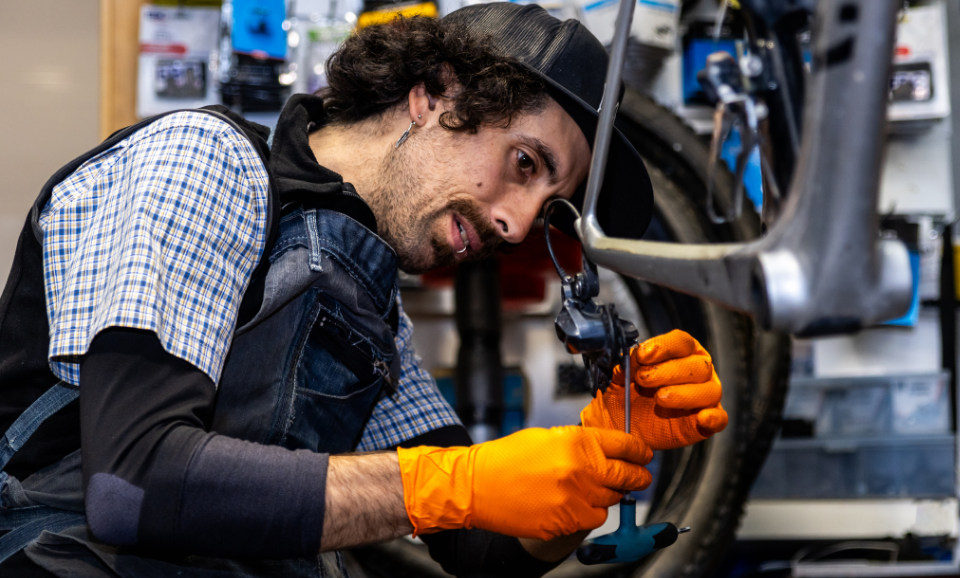
Before you put your bike away, give it a proper wash. Use a gentle cleaner (such as washing-up liquid or a dedicated bike shampoo) and a soft brush. Dirt traps moisture, and road salt causes corrosion. After washing, dry the bike and lubricate the chain, cables and derailleurs. It’s worth taking care of this when you park the bike in its winter spot, to avoid the extra costs that can arise from skipping this first and most important step. According to Strava Insights research, cycling traffic in Poland drops by 68% in winter, and one in five cyclists admits they don’t check the technical condition of their bike before the next season.

2. Where should you keep your bike in winter?
The best place is a dry, ventilated garage or cellar. Avoid spaces where the temperature drops below zero. Metal parts can contract, and tyres harden. If you have to leave your bike on the balcony, use a breathable cover (not a plastic one!) and stand it on pads to insulate it from the concrete. Remember to check on your bike whenever you can, so a thief never gets the impression that the place is unattended. Thieves often watch an owner’s hourly or daily routine before a theft. It’s worth checking on your belongings at varying times 🙂
3. How to protect your bike against theft
In winter, a bike sits untouched for weeks. For thieves that’s the perfect opportunity, because there’s no need to hurry and nobody will notice the bike is missing straight away. Data from the Polish National Police Headquarters shows that the average value of a stolen bike in Poland exceeds PLN 2,800, and for e-bikes as much as PLN 9,000. That’s why, even in a cellar or garage, it’s worth using solid bike security.
A good solution is to combine different types of lock – for example a Gold-rated U-lock (Kryptonite, Abus) and a steel chain for the rear wheel. It’s also worth having a permanent anchor point: a ground anchor in the wall or a metal bar.
“A thief usually has one specific tool. If they see two different locks, they give up. It’s a matter of time and noise”
This approach makes economic sense too: a solid lock costs around 5–10% of the bike’s value, and it can save a bike worth many times more.

4. Technology keeping watch – a GPS tracker for your bike
Good bike security is half the battle. The other half is a GPS tracker, which lets you check that your bike is still where you left it.
Modern bike GPS trackers can:
- run for several weeks on a single charge,
- send an alert when the bike moves,
- show route history in the app,
- help the police recover your bike.
What is the best tracker for a bike?
If you have an e-bike, choose a model powered by the bike’s battery, such as notiOne GPS Connect, which is mounted inside the frame. That way it works without interruption and you don’t have to remember to charge it. If you have a regular bike, we recommend notiOne GPS PLUS. It’s a device with a high-capacity battery that will easily see you through the winter season.
5. A bit of strategy: marking and documentation
Take photos of your bike (especially the frame number and any distinctive features) and save the details in an app or in the cloud. If it’s stolen, you can pass them on to the police in an instant. It’s also worth marking your bike with an invisible UV marker – the police are increasingly using ultraviolet lamps to identify recovered bikes. An interesting point here is that if you have a notiOne GPS Connect GPS tracker, you can store all of this in the free app. You get both a tracker and a bike passport where you can keep all the information you need.
Bonus: how to “wake up” your bike after winter?
In spring, don’t just jump straight on. Check the tyre pressure, brakes and chain. Go for a short test ride, and if you have a GPS tracker, refresh the app and make sure everything is working properly.
Summary: winter peace of mind is a matter of preparation
There is no single magic answer to how to protect your bike against theft and winter wear.
The best results come from combining a few simple steps:
- cleaning and maintenance,
- a suitable place to store it,
- good bike locks and immobilisers,
- and technological back-up – an anti-theft GPS tracker.
That way, come spring, all you need to do is pump up the tyres and hit the road – without stress or unnecessary expense.