How do you choose a bike for your child that’s healthy, comfortable and safe for them? What should you look out for? How do you match the frame size? How many inches should the wheels be? Here are some valuable tips that will certainly make the job easier, especially now that a bike is still the best First Communion (komunia) gift for a child!
When can a child start learning to ride a bike?
Manufacturers of children’s bikes suggest children can start learning to ride at the age of 2. It all depends on the pace of the child’s psychomotor development and their ability to stand on their own two feet and walk steadily.
Good preparation for learning to ride a bike before a child’s second birthday are ride-on toys and balance bikes. These teach your little one to balance their body, improve their motor coordination and learn to keep their balance.
The next stage is a small bike with stabilisers and 12-inch wheels, which a 2-year-old can already ride. However, it’s really 3–4-year-olds who will get the most fun out of a bike like this, and they’ll also learn to pedal and brake on their own more quickly. Only with time, once the child has gained some practice, can you remove the stabilisers and start learning on a regular two-wheeler.
For the youngest – a balance bike
That is, a bike the child pushes along the ground with their feet. A child’s bike like this has no pedals and no stabilisers. It’s the best way to learn to keep balance and control the body. You can choose between wooden and metal bikes. The former are usually a little lighter, which makes them more comfortable to use. When choosing the size, make sure the child can push off the ground freely with their feet.
A child’s bike: city bike or MTB?
Once your child has mastered balancing on a balance bike, or is old enough to start their adventure on a traditional bike, it’s worth thinking about the kind of surface they’ll be riding on most often. For cycle paths or park lanes, a children’s city bike will work perfectly. On dirt roads and in forests, the child will need a bike with a sturdier, shock-absorbing construction: a BMX or MTB (mountain bike).
What wheel size should you choose for a child’s bike?
The size of a child’s bike can be chosen based on the child’s height:
- From 80 to 108 cm – 12-inch wheels, usually children aged 2–4; a balance bike is the best choice.
- From 95 to 122 cm – 16-inch wheels, usually children aged 4–6; a small bike with pedals and/or stabilisers is the best choice.
- From 110 to 135 cm – 20-inch wheels, usually children aged 5–8; a medium-sized bike with pedals is the best choice.
- From 145 cm – wheels of 24 inches and up, for children aged 9 and over; a junior bike with pedals is the best choice.
How to match the bike frame size to your child
To ensure safety, healthy development and comfort when choosing a bike for a child, we need to take into account the child’s height and their inside leg length. We should also remember that they need to be able to touch the ground with their toes while sitting on the saddle – the lower their skills, the more of the foot should touch the ground. Here is the size table:
| Child’s age | Leg length | Frame size | Wheel size |
| 4 – 5 | 45 – 48 cm | none | 16’’ |
| 5 – 6 | 48 – 53 cm | 11’’ | 16’’ |
| 6 – 7 | 53 – 56 cm | 12’’ | 20’’ |
| 7 – 8 | 56 – 60 cm | 13’’ | 20’’ |
| 8 – 10 | 60 – 66 cm | 14’’ | 24’’ |
| 10 – 12 | 66 – 70 cm | 15’’ | 24’’ |
Does the weight of a child’s bike matter?
Definitely – a good child’s bike is a lightweight one. On a light two-wheeler it’s much easier to keep balance and control the ride. What’s more, a lighter bike is far easier to carry when the child comes across stairs or other obstacles that force them to lift it.
Extra equipment for a child’s bike
The mandatory bike equipment includes:
- A front light (white or yellow) with a steady or flashing beam.
- A rear light with a steady or flashing beam.
- A working brake.
- A device that emits an audible signal – a bell.
Beyond the mandatory equipment, it’s also worth kitting your child out with:
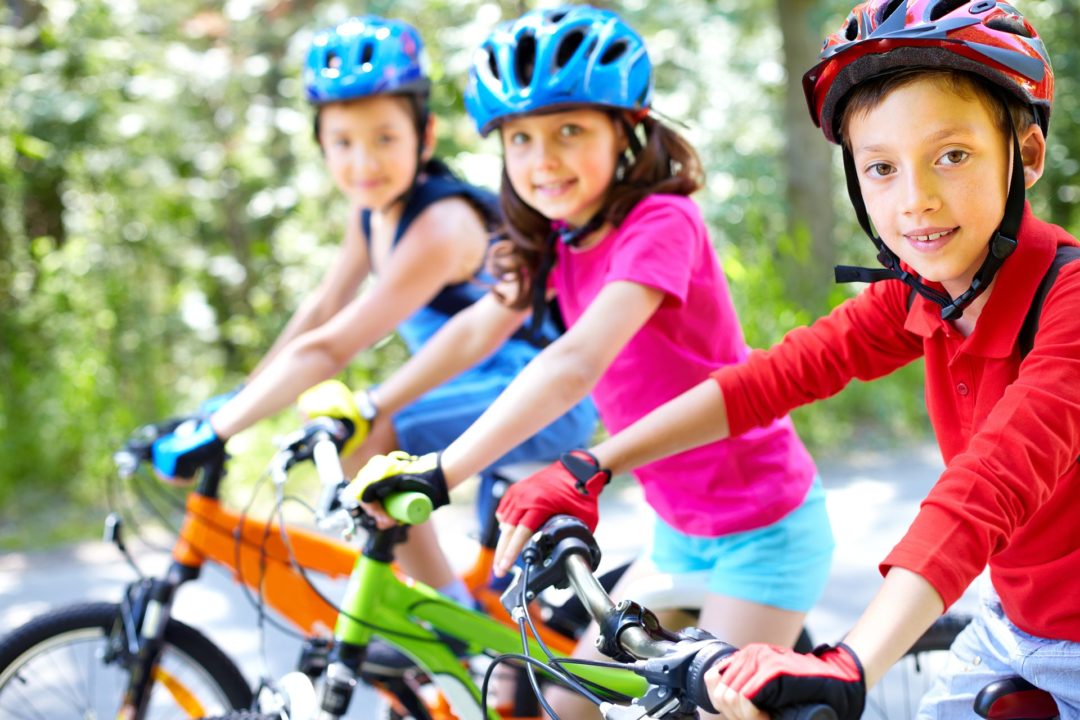
- A helmet – it will protect your child’s head in the event of an accident.
- Knee and elbow pads – particularly useful for beginner cyclists, who still have the odd minor tumble.
- A water bottle – handy for a child who enjoys all-day bike rides.
- A rear rack – if your child will be cycling to school, they can carry a few extra accessories on the rack.
- Reflectors – it’s a good idea to fit a few reflective elements to your child’s bike and also equip them with, for example, a reflective harness or vest.
- Good anti-theft protection – ideally a good lock so the child can secure the bike in a suitable spot, or a bike immobiliser that stops the bike from being ridden away.
- A tracker – notiOne go! will come in handy for parents, who can keep an eye on the location of their child’s bike and quickly find it if the child leaves it somewhere.

Protecting your child’s bike
Children’s bikes easily fall prey to thieves. That means not only costs, but also heartbreak for the little owners. A bike like this is easy to steal – children absorbed in play often leave their bikes unattended. A moment’s inattention, and the bike is gone.
- Traditional cable locks – available in every shop, they’re of little real value. Cutting through one takes a few seconds. Honestly a waste of money.
- Folding locks, while not a 100% guarantee, are a much better choice. Their Achilles’ heel is the rivets, which are easy to take apart with the right tool.
- A U-lock or a dedicated bike chain – these are locks you can buy in any larger bike shop or online. They’re the best option available on the market.
- A bike tracker – a compact bike tracker hidden in a discreet spot makes an excellent addition to any lock.
We also recommend our other articles – read: Protecting your bike against theft – the 5 best ways