Published: 27 August 2026
The best protection against car theft is made up of several independent elements. The first is a GPS tracker, which lets you quickly detect that the car is moving, check its position and pass the data on to the police. A more mechanical measure, the immobiliser, makes it significantly harder to start the engine. A steering-wheel or gearbox lock delays the getaway. Some thieves will give up at the mere sight of a steering-wheel lock because of the noise and hassle involved. To be honest, though, it’s only this combination that creates effective anti-theft protection.
It also has to be said honestly that GPS alone won’t stop a thief. What it can do is shorten the time until the owner first reacts. The police also point to GPS trackers as a solution that can help recover a car. After all, there are now plenty of stories where a modern GPS tracker, fitted as extra protection for a car, helped break up organised criminal groups.
What role does a GPS tracker play in protecting your vehicle?
A GPS tracker alerts you to unauthorised movement and helps establish the car’s location. A good GPS tracking system works without constant attention. It sends data to an app that shows the last known location and alarm notifications. It’s an extra layer of protection you can add to the car and forget about. If something happens that needs your reaction, a modern GPS tracker will let you know by itself.
GPS monitoring also lets you retrace the route and check the distance driven, the time and the speed.

How does a GPS tracker work?
The tracker works out its position from satellite signals. It then sends the data over the mobile network to the app. The owner’s phone doesn’t need to be anywhere near the car. That’s the fundamental difference between a GPS tracker and a Bluetooth tracker.
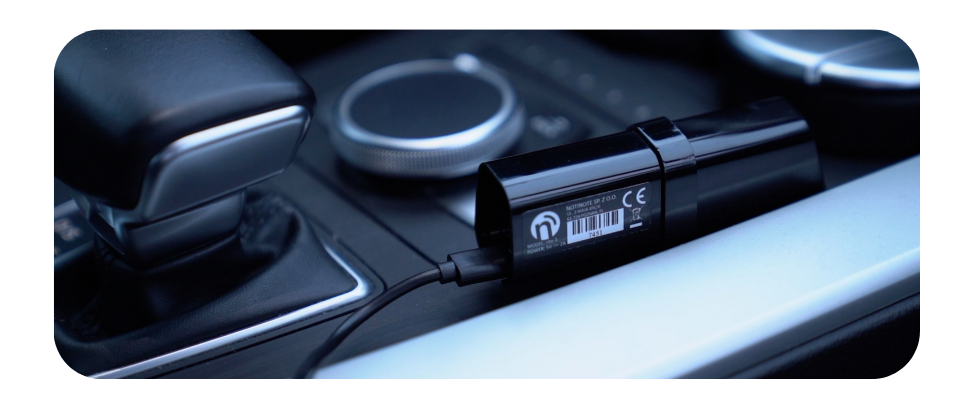
A modern GPS tracker can run on its own battery or on the car’s electrical system. A portable model is easier to hide and move around. A device powered by the car doesn’t need charging, but usually needs to be fitted by an installer.
One example of a portable device is the notiOne GPS PLUS. It offers accuracy of up to 2.5 m, 4G LTE connectivity, location history for up to 90 days and a LIVE mode that runs for 30 minutes. It also has a 2800 mAh battery. The stated operating time is over 60 days, but this depends on the settings, reporting frequency and signal conditions.
The tracker should be hidden, but not completely shielded by metal. Before using it permanently, it’s worth doing a test drive. Check the position updates, the movement alert and the app.

Geofencing as a GPS tracker feature
A geofence is a virtual zone marked out on the map. When the car leaves or enters that area, the app sends a notification. This feature doesn’t immobilise the vehicle. It does, however, tell the owner that the car has ended up outside the permitted area.
You can set the zone around your home or car park. It shouldn’t be too small. Location accuracy depends on the surroundings, so a narrow zone can cause false alarms.
Geofencing works best combined with a movement alert. The first alarm tells you the device has been moved. The second confirms it has left the area.
What threats do GPS systems face?
To be fair, every monitoring system has its limits. The GPS signal can weaken in an underground car park, a tunnel or a steel container. Data transmission can also be interrupted in a place with no mobile network coverage. The app will then show the last correctly transmitted position rather than the car’s current location.
It should be added, though, that GPS systems automatically resume working the moment coverage or signal is restored.

GPS jammers and how to counter them
GPS jammers generate radio interference. They can block reception of the satellite signal or GSM and LTE communication. Poland’s Office of Electronic Communications (UKE) points out that jammers can interfere with GPS, mobile telephony and data-transmission devices. Such devices cannot legally be placed on the civilian market in Poland or the European Union.
There is no simple in-app feature that will completely eliminate GPS jamming. You can, however, limit the effects of an attack:
- hide the tracker without cutting off its access to the signal;
- turn on the movement alert and react to a sudden loss of reporting;
- keep the last known position and the route history;
- add an independent system or a mechanical lock.
Two GPS trackers placed in different parts of the car offer no guarantee. A powerful GPS jammer can affect both. What matters more is a variety of safeguards.
How to set up an immobiliser and GPS?
As a rule, the immobiliser should use a form of authorisation other than the factory key. This could be a code, a small ID tag or a sequence of buttons. Installation should be left to a professional installer who will match the solution to the electronics of your particular car model.
The GPS tracker should work independently of the immobiliser. Choose a device with its own battery, a movement alert, location history and battery-level information. Once it’s fitted, run a short test:
- lock the car and activate the anti-theft alert;
- move the car or drive a few hundred metres;
- check how long it takes for the notification to arrive;
- open the map and assess the accuracy of the position;
- make sure the app shows the last route and the battery level.
Repeat the test whenever you change the device’s hiding place, and every few weeks.
Which mechanical lock should you choose?
A steering-wheel lock is a good choice if you want low cost and quick fitting. It should be made of hardened steel, have a shielded lock cylinder and fit tightly around the steering wheel. Cheap, lightweight models are mostly just for show.
The costs and benefits of investing in GPS
The cost of protection needs to be weighed against the value of the car and the risk of theft. A portable GPS tracker is the simplest solution. A system with an immobiliser costs more but makes driving away harder. Radio-based GPS and SVR anti-theft systems are intended mainly for expensive vehicles.
When choosing, it’s worth working out the full cost over three years:
| Element | What to include in the calculation | Main benefit |
|---|---|---|
| Portable tracker | price of the device, data transmission, any additional services | alerts and position view |
| Permanently fitted GPS | device, installation, subscription, servicing | constant power and frequent reporting |
| Additional immobiliser | device, professional installation | makes starting the engine harder |
| Mechanical lock | purchase and fitting | a visible obstacle independent of electronics |
| SVR radio system | installation, activation and service fee | support in searching for the car after a theft |
Some insurers offer discounts on comprehensive (AC) insurance once an approved security device has been fitted. This isn’t a rule. Before buying, it’s worth asking for written confirmation of the terms.
FAQ – GPS trackers in cars
Yes, as long as it has its own battery or a permanent power supply from the car’s electrical system.
No. Notifications can also arrive when the app is running in the background.
It needs mobile connectivity to transmit its location. The SIM card or eSIM may already be built into the device.
Yes, if the tracker supports roaming in the country in question. It’s worth checking the service coverage before you travel.
A model with its own battery puts no load on the car battery. With a permanently fitted device, it depends on how it is installed.
Yes. The tracker works independently of the key and can send an alert as soon as the car starts moving.