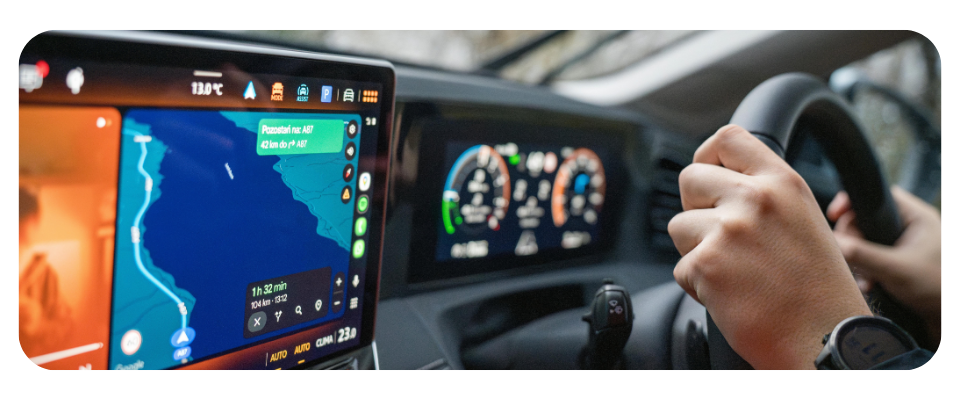
GPS is a satellite navigation system that makes it possible to determine a device’s position on Earth. It’s used by phones, cars, sports watches, aircraft, ships, map apps and many other devices. GPS works thanks to satellites orbiting the Earth. A device with a GPS receiver picks up their signals and uses them to calculate its location.
GPS relies on signals sent by satellites. The device receives signals from several satellites and calculates its position based on how long each signal took to reach the receiver. In practice, the device needs to pick up signals from several satellites to determine its location. The better the access to the satellite signal, the easier it is to pinpoint an accurate position.
How does GPS work, in simple terms?
- GPS satellites send out a signal.
- A device with a GPS receiver picks up the signal from several satellites.
- The receiver calculates its distance from the satellites.
- The system determines the device’s position on Earth.
- An app, map or navigation system shows the location to the user.
GPS works best where the device has a clear view of the sky. In a tunnel, underground car park, basement or under a thick metal cover, the signal may be weak or unavailable.
Does GPS work without the internet?
Yes, GPS can determine a position without the internet because it uses satellite signals. The internet is only needed when the device has to download a map, send its location or display additional data in an app. This is one of the most common misconceptions. GPS and the internet are not the same thing. GPS is responsible for determining the position. The internet may be needed to download a map, update a route, share a location with someone else or send data to an app.
| Function | Does it need the internet? |
|---|---|
| Receiving the GPS signal | No |
| Determining the position with the GPS receiver | No |
| Downloading an online map | Yes |
| Planning a route with live traffic | Yes |
| Sending the location to an app | Yes |
| Sharing the location with someone else | Yes |
This is why a phone can get a GPS fix without the internet, but without a network connection it may not be able to download an up-to-date map or traffic data.

How accurate is GPS?
In good conditions, GPS can show a location to within a few metres. Accuracy, however, depends on the number of available satellites, the quality of the receiver, surrounding buildings, terrain obstacles and where the device is located. GPS doesn’t always show the location perfectly. That’s normal. Satellite technology needs the best possible access to the signal from the sky. The best conditions for GPS are open spaces. The most difficult conditions are tunnels, underground car parks, basements, densely built-up areas and places shielded by metal.
GPS may show an inaccurate location when the satellite signal is weakened, reflected or blocked by buildings, trees, a roof, a tunnel or metal elements. GPS works best outdoors. In buildings, underground car parks and tunnels, the satellite signal may be weak or unavailable. The GPS signal comes from satellites, so it needs as open a space as possible. Walls, ceilings, roofs and metal structures make it harder to receive.
| Location | Does GPS work well? |
|---|---|
| Open-air car park | Yes |
| Road | Yes |
| Park | Usually yes |
| Forest | Usually yes, but less well |
| Densely built-up area | It varies |
| Home | Often less well |
| Underground car park | Usually not |
| Tunnel | No |
In practice, in difficult locations a GPS device may show the last recorded location or need more time to re-establish its position after coming back out into the open.

GPS in different devices
GPS works on the same principle regardless of the device: it receives signals from satellites and helps determine the position. The difference lies in how the GPS data is used afterwards. A phone combines GPS with maps, Wi-Fi, the mobile network and apps to show the location faster. A car sat nav uses GPS to guide you along a route, and a sports watch uses it to record distance, pace and the course of your workout.
GPS is not the same as a map, though. GPS determines where the device is, the map shows that position on the screen, and the navigation system analyses the route and tells you where to turn. It’s also worth remembering that GPS itself only receives signals from satellites and doesn’t send out any data about the user – but privacy depends on the apps and devices that use your location. That’s why it’s a good idea to check which apps have access to your location and whether they really need it.
The key facts about GPS in brief
GPS is a satellite system for determining a device’s position. It works without the internet, but the internet may be needed for maps, apps and data transfer. GPS works best outdoors, and its accuracy depends on the surrounding conditions.
The most important things to remember:
| Question | Short answer |
|---|---|
| What is GPS? | A satellite system for determining position |
| Does GPS work without the internet? | Yes, GPS itself doesn’t need the internet |
| Does GPS work inside a building? | It can, but usually less well |
| Where does GPS work best? | In open spaces |
| What does GPS accuracy depend on? | The signal, satellites, obstacles and receiver quality |
| Are GPS and a map the same thing? | No, GPS determines the position and the map shows it |
| Is GPS only used in cars? | No, it’s also used by phones, watches, transport, sport and emergency services |
GPS is one of those technologies that have become part of everyday life. It helps you reach your destination, record a training route, find a place on the map and use many location-based services.
Frequently asked questions:
GPS is a satellite navigation system that makes it possible to determine a device’s position on Earth. It’s used by phones, watches, cars, sat navs and map apps, among others.
GPS works thanks to satellites. A device receives signals from several satellites and uses them to calculate its location.
Yes. GPS can determine a position without the internet because it uses satellite signals. However, an internet connection may be needed to download a map, plan a route online or send a location to an app.
GPS can work inside a building, but usually less well than outdoors. Walls, roofs, ceilings and metal elements can limit the satellite signal.
In good conditions, GPS can show a location to within a few metres. Accuracy drops in tunnels, garages, buildings, forests and densely built-up areas.
No. GPS determines the location, and the map shows it to the user. A map on its own, without GPS data, doesn’t know where the device is.
Yes. Using GPS consumes battery power, especially when the device checks its location frequently, records a route or runs with an active map app.