Updated: March 2026
Where is my phone? That question usually comes up when your smartphone vanishes from your pocket, gets left in the car or simply isn’t within reach. The good news is that today a phone can often be found from your Google or Apple account. And in many cases you can also check its last known location.
Phone location is a feature that helps with more than just navigation. It also helps when you want to quickly check where my phone is, find a lost device or secure your data after a theft. On Android this is handled by Google Find Hub / Find My Device, and on the iPhone by the Apple Find My app.
Where is my phone and how do I check its location as quickly as possible?
Thanks to GPS location, you can check where your phone is, see its position on a map, trace the route of a journey or use location sharing with someone close to you. But only if they’ve given their consent beforehand. In practice, simply typing in a phone number usually isn’t enough. Legal location sharing most often works through Google Maps, Family Link or Apple Find My, when the other person switches the feature on themselves.
My location on Android – where’s the quickest place to check it?
If you want to see my location on the map (that is, check your own phone’s position), on Android you’ll usually do this through Google Maps. Open the app → tap the blue dot → you’ll see the exact location of your phone and the level of GPS accuracy. In your phone’s settings, it’s worth going to Settings → Location → Google Location Accuracy so the system works more precisely in the city or inside buildings. This is the feature behind the phrases users often type in: “Google phone locating”, “my GPS location” or “where am I map”.
It also makes using public transport easier, thanks to dedicated apps on your phone such as Google Maps or Jakdojade. It supports you when travelling, letting you find tourist attractions, hotels or restaurants.
Your phone’s location system also powers sports apps such as Strava. It collects data about your workout and the distance covered during it.
Location is also used for photo geotags, which record where a photo was taken by the camera in your smartphone. Of course, GPS coordinates are also read by social media, which raises plenty of controversy.
Navigation is also used in the entertainment sector to create apps, games and other solutions that engage users.
This feature is also essential when you lose your phone or it gets stolen. You can then easily find it using the right coordinates. It also comes in handy when you get lost or don’t know which way to go in an unfamiliar city.
There is just one condition for it to work properly: you need to have signal. In fact, the condition for it to work properly depends on the situation. GPS can work without mobile signal, but to display maps and refresh data you often need the internet (Wi-Fi or a mobile network). Inside buildings, accuracy may drop.

How does phone location work?
Location on your phone is based on the GPS system (Global Positioning System), which uses 31 satellites orbiting the Earth and ground control stations.
The system was created by the United States Department of Defense, and its original purpose was to support military operations.
It was handed over to private users as early as the 1990s, however, and remains a hugely popular solution to this day. In practice, this means that my GPS location shown on a phone map is, for civilian use, usually accurate to around 4 to 12 metres – roughly the width of a small street or two to three parking spaces.
A phone is located with the help of the GPS receiver built into the smartphone. It picks up the signal sent by the satellites and works out its own location from that information. It’s estimated that over 90% of smartphones have the device location feature switched on, and as many as 75% of users have used the “Find my phone” option at least once.

Is phone location the same as tracking?
No – it’s a tool that improves safety. It lets you find a lost device, track the phone number of someone close to you, and respond quickly in emergencies. Phone tracking is also widely used by companies for fleet management, in the courier industry, and by parents who want to be sure where their child is.
It also supports businesses in running their operations, from small companies to huge corporations. It lets parents check where their child is and allows you to find the location of a loved one while they’re travelling.
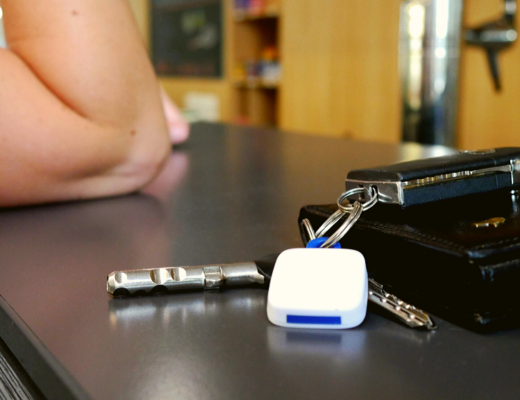
The ability to determine location is hugely important in the work of detectives, police officers and even health services. It makes it easier to pinpoint the position of people who are injured, missing or hurt. The range of uses that location technology gives us is also exploited by small electronic devices. You can drop them in a wallet or handbag, attach them to your keys or hide them in a bike. One such key-ring-sized Bluetooth tracker is the notiOne go! PLUS, which shows you where your item is in its dedicated app.
Is phone location safe?
Yes, phone location can be safe if you use it consciously and control which apps have access to it. Both Android and iPhone let you manage location permissions, and the official device-finding services have additional data-protection mechanisms. Apple describes Find My’s safeguards as being built on strong privacy protection, and Google highlights the encrypted location information in the Find Hub network.
In practice, it’s worth regularly checking which apps have access to your location and sharing it only when it’s genuinely needed.
The location feature isn’t there for spying – it’s there to improve safety, for example when finding a lost phone, keeping an eye on a child or tracking parcels.

How to locate a lost or stolen phone?
If you lose your smartphone, it’s best to use the manufacturer’s official tools. On Android that’s Google Find Hub / Find My Device, and on the iPhone it’s Apple Find My. They let you check the phone’s location on a map, mark the device as lost, lock it and, if necessary, remotely erase its data.
It’s worth knowing, though, that an internet connection isn’t always the only requirement. In many cases the system can show the last known location. Modern solutions such as Apple Find My and Google Find Hub can also help with offline devices, provided they were set up correctly beforehand.