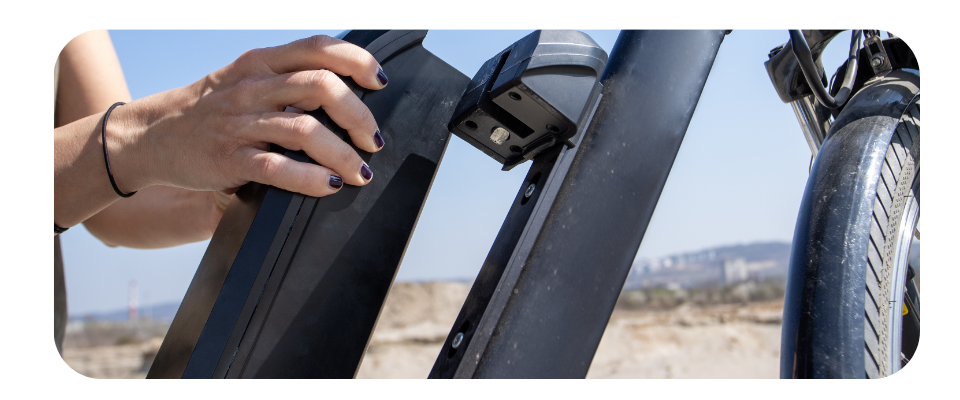
The lifespan of an e-bike battery increases when you keep it in the middle of its charge range. It’s important to charge it at a safe temperature, which means avoiding running it down to zero. And remember to use the dedicated charger. Here are 5 simple habits that will help you look after your battery effectively.
Rules that give a lithium-ion battery a longer life
- For longer periods of storage, keep the battery at 30–60% charge in a dry room at room temperature.
- Charge at a temperature the BMS allows – in Bosch systems, charging is blocked outside 0–40°C.
- Don’t make running the battery “down to zero” a ritual. Regular deep discharges shorten the life of the cells (this is not “calibration”). Bosch explicitly recommends avoiding frequent drops to 0%.
- Use the original charger (or the charger made by the system manufacturer). A cheaper substitute can kill the BMS or end in overheating and a voided warranty.
- If you install an anti-theft system, choose one with its own battery – such as notiOne GPS Connect.
Remember not to leave the battery sitting at 100% or 0% for months. That’s the quickest route to a drop in capacity (followed by complaints that “the e-bike’s range has collapsed”). If you’re not riding, set it to a “storage” level and leave it alone.

What types of e-bike batteries are there?
Today the market is dominated by lithium-ion (Li-ion) batteries. Lithium-polymer (LiPo) batteries are less common. Nickel-metal hydride (NiMH) batteries are, in practice, an older generation.
Lithium-ion batteries: performance and durability
This is the standard in most e-bikes (city, trekking and MTB). What matters here is the Wh rating (energy), the BMS battery management system, and cooling/fit within the frame. For the user, what should count is not the “marketing” but how the battery copes with temperature and how it charges. The advantage of this type of battery is potentially higher energy density for the same weight. The downside is higher demands on the quality of the pack and its safety features. It’s not a popular solution in e-bikes.
What other types of e-bike battery are there?
Batteries other than lithium-ion are ones that often differ in form and mounting rather than in cell chemistry.
- Down tube battery (in the down tube / PowerTube): low centre of gravity, the best handling.
- Rear rack battery (on the carrier): popular in city bikes, easy access, but the weight sits higher.
- Bottle battery: mounted in place of the bottle cage – a simple upgrade, but with limited capacity.
- Silverfish battery: the classic “chunky” pack on the frame or rack, often found in older designs.
- Frog battery: compact, usually for lighter bikes and shorter routes.
- You’ll also come across descriptions such as “trapezoid battery” – again, this is a matter of shape and casing.

What are the technical parameters of an e-bike battery?
The basic technical parameters of an e-bike battery are voltage, battery capacity and the BMS battery management system.
Voltage (V) defines compatibility with the motor and controller. You don’t buy a “better” battery by choosing a higher voltage – you buy one that fits. Most often you’ll come across e-bike batteries rated at 36V and 48V (depending on the system). Battery capacity versus e-bike range is simple maths: Wh / (Wh per km) = km. Capacity in Wh matters more than Ah alone.
Practical energy consumption ranges:
- relaxed city riding: ~8–12 Wh/km
- mixed routes/wind/hills: ~12–18 Wh/km
- hard MTB riding with lots of climbing: ~18–25 Wh/km
How many Wh do you need for specific “ranges of up to 60 km / 65 km / 85 km”?
- 60 km: 60 × 12 Wh/km = 720 Wh
- 65 km: 65 × 12 Wh/km = 780 Wh
- 85 km: 85 × 12 Wh/km = 1020 Wh
This is why “high battery capacity” alone doesn’t guarantee results: the bike’s weight, tyres, wind and riding style can change the real-world figure by tens of percent. The BMS battery management system looks after the safety and health of the cells: temperature, currents, cell balance and cut-offs.
What the BMS does in practice:
- blocks charging outside the safe temperature range (e.g. 0–40°C in Bosch systems),
- cuts off the battery when the voltage is too low,
- balances the cells (equalises their voltages), which contributes to stable range and a long lifespan.

How to charge an e-bike battery correctly
Charge in a dry place, at room temperature, with the original charger, and don’t make a sport of running it down to “zero”. Manufacturers’ materials and guides explicitly recommend sticking to the system charger and avoiding dubious substitutes.
- Temperature matters: in Bosch systems, charging only works within the 0–40°C range.
- In winter: store and charge the battery at home; put it in the bike just before you ride.
- Longer winter break (Shimano’s practice): charge to around 70%, store at a stable 10–20°C, and top up to around 70% every 6 months.
- Longer storage (Bosch’s practice): 30–60% charge, a dry room, ideally with a smoke detector.
The future of e-bike batteries: technologies and trends for 2026
- LFP is spreading because it’s cheaper and safer:
- LFP (lithium iron phosphate) chemistry is growing in mass-market applications because it lowers costs and improves safety. In the EV market alone, LFP’s share is rising sharply worldwide. This shapes customer expectations in the “light mobility” segment too (which includes e-bikes, among others).
- Sodium-ion is moving out of the lab and into mass production
- CATL announced the start of mass production of its sodium-ion technology (Naxtra) at the end of 2025. This matters because sodium-ion offers a strong winter-performance argument and potentially lower cost. For e-bikes, the key question is whether manufacturers will turn it into packs with a sensible Wh/kg and a stable BMS.
- EU regulations: the “battery passport” for e-bikes is entering the home straight
- The EU already has the Battery Regulation (2023/1542), and for “light means of transport” batteries (including e-bikes) the digital battery passport becomes mandatory from 18 February 2027. 2026 is effectively the year of preparation and implementation for manufacturers and the supply chain.
- The e-bike as a connected device (security and notifications)
- notiOne GPS Connect is a tracker for e-bikes designed for concealed installation, which lets you set up notifications and safe zones in the app, among other things (you get an alert when the bike leaves a designated area). It’s a “security layer” that doesn’t depend on which battery chemistry ends up dominating in 2–3 years’ time.